Discover how to boost conversions and engagement with FX Pop-Up strategies. This guide covers high-performing techniques, smart timing, and personalization tips to help you grow your online business effectively using FX Pop-Up tools.
Understanding FX Pop-Ups in Digital Marketing
What Are FX Pop-Ups?
If you’ve spent even a few minutes browsing online, chances are you’ve encountered a pop-up asking for your email, offering a discount, or nudging you to take action. These are what we call FX pop-ups—dynamic, conversion-focused overlays designed to grab attention and guide user behavior. They’re not just random interruptions; they’re carefully engineered tools built to capture leads, boost engagement, and increase conversions.
Think of FX pop-ups like a salesperson who knows exactly when to approach you in a store. They don’t interrupt you the moment you walk in—they wait until you show interest. That’s exactly how modern pop-ups work. They use triggers like time spent on a page, scrolling behavior, or exit intent to show the right message at the right moment.
The evolution of pop-ups has been fascinating. Earlier versions were intrusive and often annoying, but today’s FX pop-ups are smarter, more personalized, and far more effective. Businesses now use them not just for email capture but also for upselling, cross-selling, and customer retention strategies.
Why Pop-Ups Still Matter in 2026
You might wonder—aren’t pop-ups outdated? Surprisingly, they’re more relevant than ever. With digital competition skyrocketing, businesses are constantly looking for ways to stand out and convert visitors quickly. Pop-ups offer a direct line to users, cutting through the noise of crowded web pages.
Recent data shows that the average popup conversion rate is around 4.82% in 2026, with top performers reaching as high as 57% . That’s not just effective—that’s powerful. It means that nearly 1 in 20 visitors can convert through a well-optimized pop-up.
At the same time, user expectations are evolving. People want relevance, speed, and value. That’s why modern FX pop-ups focus on personalization and timing, rather than just visibility. When done right, they feel less like interruptions and more like helpful suggestions.
The Psychology Behind High-Converting Pop-Ups
User Behavior and Attention Span
Let’s be honest—people online have the attention span of a goldfish. In actuality, people frequently make the decision to leave or remain on a page in a matter of seconds. That’s where FX pop-ups come into play. They act as a strategic interruption, redirecting attention at critical moments.
Psychologically, humans respond to urgency, curiosity, and rewards. A pop-up offering “10% off if you sign up now” taps into all three. It creates urgency (limited-time), curiosity (what’s the offer?), and reward (discount). This combination makes pop-ups incredibly persuasive.
However, there’s a fine line between persuasion and annoyance. Studies show that excessive pop-ups can frustrate users and degrade the overall experience . That’s why balance is key. The goal is to guide, not overwhelm.
Trigger-Based Engagement
Modern FX pop-ups rely heavily on triggers. Instead of appearing randomly, they’re activated based on user behavior. For example:
- Exit intent triggers when a user is about to leave
- Scroll triggers activate after reading a portion of content
- Time-based triggers appear after a delay
These triggers significantly improve performance. In fact, campaigns using time-on-page triggers can outperform others by up to 25% .
It’s like having a sixth sense about your visitors—knowing exactly when they’re ready to engage. And when you hit that moment perfectly, conversions naturally follow.
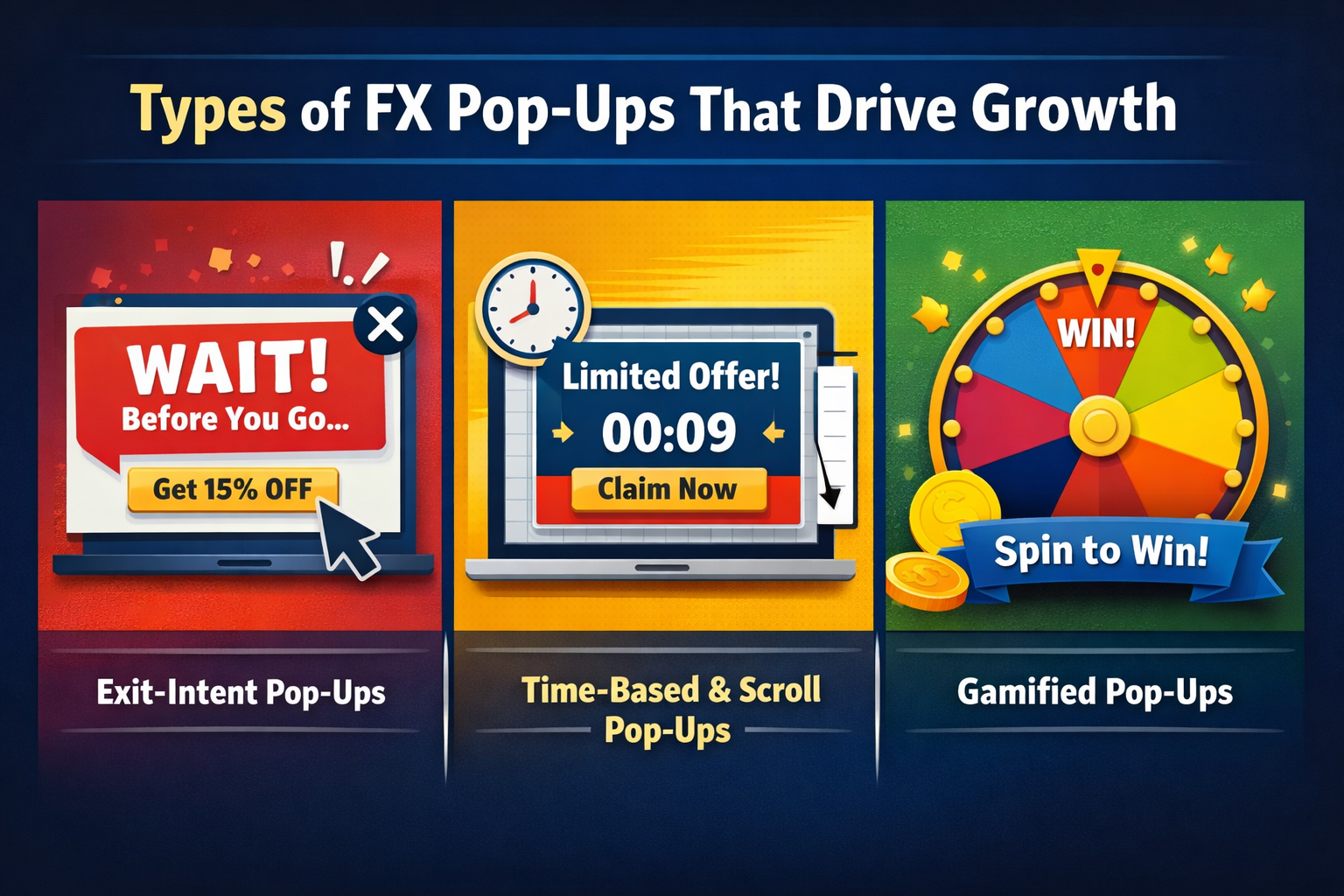
Types of FX Pop-Ups That Drive Growth
Exit-Intent Pop-Ups
Exit-intent pop-ups are the digital equivalent of saying, “Wait, before you go!” They detect when a user is about to leave and present a last-minute offer. This could be a discount, free resource, or even a reminder.
These pop-ups are incredibly effective because they target users at the decision point. Instead of losing the visitor completely, you get one final chance to convert them.
Time-Based and Scroll Pop-Ups
Timing is everything. Showing a pop-up too early can annoy users, while showing it too late can miss the opportunity. That’s why time-based and scroll pop-ups are so effective.
Research suggests that a delay of 6–10 seconds yields the best conversion rates . Similarly, scroll-based triggers ensure that users have engaged with your content before being prompted.
These strategies create a natural flow, making the pop-up feel like a logical next step rather than an interruption.
Gamified Pop-Ups
Gamification is where things get exciting. Think of spin-the-wheel discounts or scratch cards. These interactive pop-ups tap into the human love for games and rewards.
Data shows that gamified pop-ups can achieve conversion rates of 3.5% or higher, outperforming traditional formats .
They turn a simple interaction into an experience. Instead of just asking for an email, you’re offering a moment of fun—and that makes all the difference.
Key Statistics That Prove Pop-Up Effectiveness
Conversion Benchmarks
Let’s break down some real numbers:
Metric | Value |
Average popup conversion rate (2026) | 4.82% |
Email popup average (2025) | 2.1% |
Top-performing campaigns | Up to 57% |
Interaction rate | 7.05% |
These numbers highlight one thing clearly—pop-ups work. But they only work when optimized.
Mobile vs Desktop Performance
Mobile is dominating the digital landscape, and pop-ups are no exception. Mobile pop-ups convert 36% better than desktop .
This makes sense when you think about it. Mobile users are more engaged, more focused, and often more action-oriented. If your pop-ups aren’t mobile-optimized, you’re leaving money on the table.
Designing High-Converting FX Pop-Ups
Visual Design and Copywriting
Design isn’t just about aesthetics—it’s about communication. A well-designed pop-up instantly tells users what’s in it for them. Clean layouts, contrasting colors, and compelling visuals can significantly boost engagement.
Adding images alone can increase click-through rates by over 25% . That’s huge. It shows how important visual appeal is in capturing attention.
Copywriting plays an equally critical role. Your message should be benefit-driven, succinct, and easy to understand. Instead of saying “Subscribe to our newsletter,” try “Get exclusive tips and 20% off your first order.” See the difference?
CTA Optimization
Your call-to-action (CTA) is the heart of your pop-up. It’s the moment of truth where users decide whether to act or not.
Effective CTAs are:
- Action-oriented (“Get My Discount”)
- Personalized (“Show Me the Deals”)
- Urgent (“Claim Now”)
Even small tweaks can lead to significant improvements. It’s all about testing and refining.
Personalization and AI in Pop-Up Strategy
Behavioral Targeting
Imagine walking into a store and being shown products tailored exactly to your interests. That’s what personalization does for pop-ups.
By analyzing user behavior—such as browsing history, location, and preferences—you can deliver highly relevant messages. Both engagement and conversion rates rise as a result.
AI-Driven Optimization
AI is revolutionizing pop-up strategies. It enables real-time personalization, predictive targeting, and continuous optimization.
According to recent trends, AI-driven personalization is becoming a standard in conversion rate optimization . AI gives businesses a huge competitive edge.
Best Timing Strategies for Maximum Impact
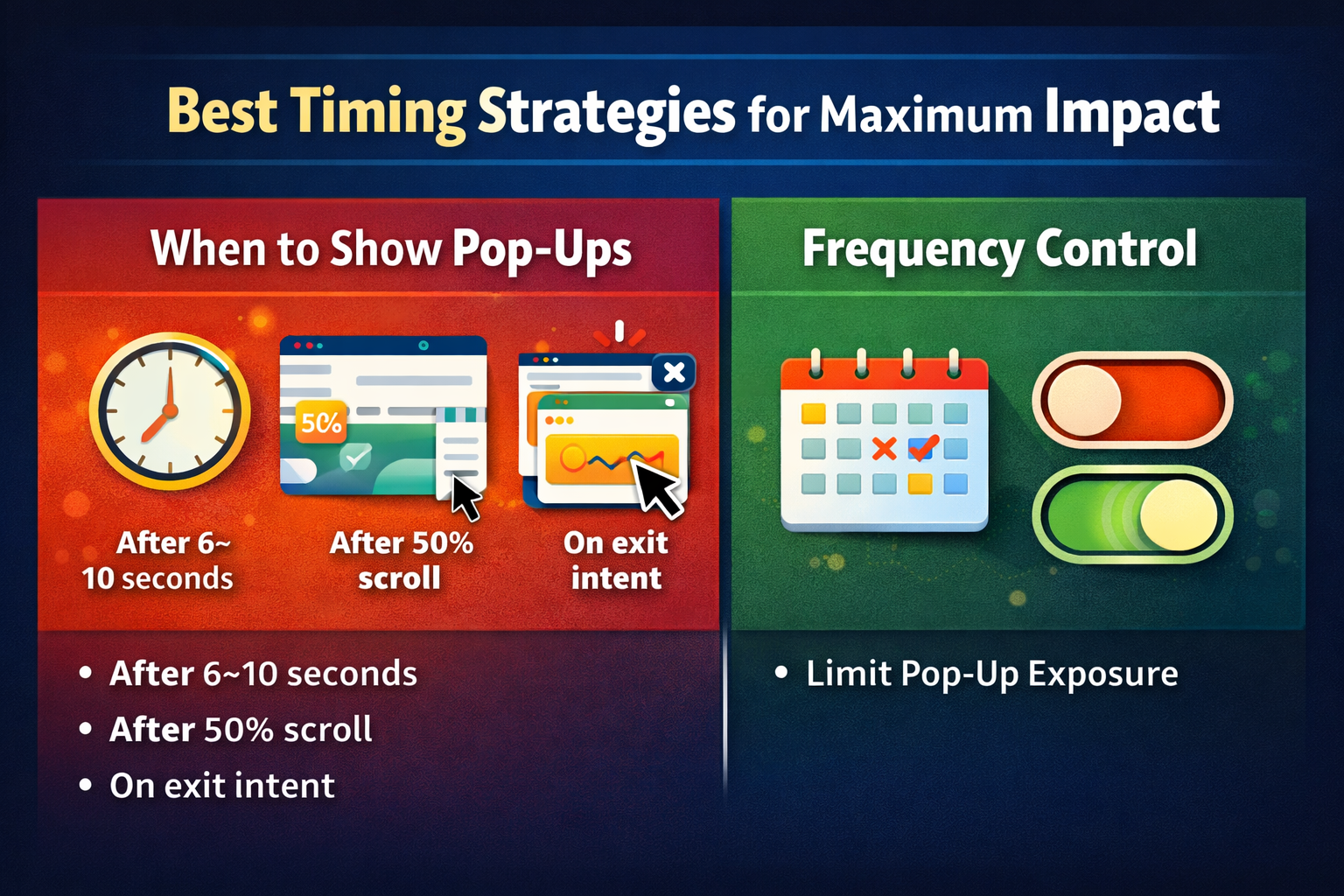
When to Show Pop-Ups
Timing can make or break your pop-up strategy. Showing a pop-up too soon can feel intrusive, while showing it too late can miss the opportunity.
The sweet spot is usually:
- After 6–10 seconds
- After 50% scroll
- On exit intent
These moments align with user engagement, making the interaction feel natural.
Frequency Control
Nobody likes being bombarded with pop-ups. Frequency control ensures that users don’t see the same message repeatedly.
Limiting pop-up exposure improves user experience and builds trust. Remember, it’s not about showing more—it’s about showing smarter.
Avoiding Common Pop-Up Mistakes
Overuse and Intrusiveness
One of the biggest mistakes businesses make is overusing pop-ups. Too many interruptions can drive users away.
Studies highlight that excessive visual elements and pop-ups can make interfaces feel cluttered and frustrating . Balance is crucial.
Poor UX Practices
Bad design, unclear messaging, and difficult close options can ruin the user experience. Always prioritize usability.
Make it simple for consumers to exit the pop-up. Ironically, giving users an easy way out can actually increase conversions.
Integrating Pop-Ups Into Your Sales Funnel
Lead Generation
Pop-ups are one of the most effective tools for building email lists. Whether it’s offering a discount or a free resource, they provide a direct way to capture leads.
Conversion Optimization
Beyond lead generation, pop-ups can drive actual sales. From upselling to cart recovery, they play a key role in the conversion funnel.
Future Trends in FX Pop-Ups
Interactive and Smart Pop-Ups
The future of pop-ups is interactive. Expect more gamification, personalization, and AI-driven experiences.
Privacy and Compliance
With increasing regulations, businesses must ensure their pop-ups are transparent and compliant. Trust is becoming a critical factor in digital marketing.
Conclusion
FX pop-ups are no longer just simple overlays—they’re powerful tools for driving online growth. When used strategically, they can capture attention, engage users, and significantly boost conversions. The key lies in understanding user behavior, optimizing timing, and delivering real value.
The digital landscape is evolving, and so are user expectations. Businesses that adapt their pop-up strategies to meet these expectations will not only survive but thrive. It’s not about using pop-ups—it’s about using them intelligently.
Frequently Asked Questions