Discover how SimpleTexting helps businesses accelerate growth through powerful SMS marketing, automated messaging, and real-time customer engagement. Learn how companies use SimpleTexting to boost conversions, improve communication, and build stronger customer relationships in today’s mobile-first world.
The Rise of SMS Marketing in the Digital Age
Why Businesses Are Moving Toward Text Messaging
Modern businesses operate in a noisy digital world. Emails pile up in inboxes, social media algorithms limit reach, and paid ads become increasingly expensive. In this crowded landscape, companies are searching for communication channels that cut through the noise and connect directly with customers. SMS marketing excels in this situation. Text messaging offers something rare in marketing today—immediate visibility. When a text message arrives, it appears directly on a customer’s phone screen, often grabbing attention instantly.
Consider your own actions. When your phone vibrates with a text message, do you ignore it for hours? Probably not. Most people check their texts almost immediately. This natural human behavior is what makes SMS marketing incredibly powerful. Businesses can deliver promotions, updates, reminders, and customer service messages directly to consumers without relying on complicated algorithms or crowded inboxes.
Another factor driving the shift toward SMS marketing is the growth of mobile device usage. Smartphones are now the primary way people interact with the internet and businesses. Instead of checking emails every hour, users communicate through messaging apps and text conversations throughout the day. Companies that meet customers where they already spend time—on their phones—gain a significant competitive advantage.
Additionally, compared to other marketing mediums, SMS feels more intimate. While emails can feel like mass communication, a text message feels like a direct conversation. This emotional perception strengthens trust and engagement between businesses and customers. Platforms like SimpleTexting leverage this advantage, helping companies send targeted, conversational messages that drive real relationships and measurable growth.
Key SMS Marketing Statistics Businesses Must Know
The power of SMS marketing becomes even clearer when you examine the data behind it. Marketing channels are often judged by engagement metrics such as open rates, response rates, and conversions. In nearly every category, SMS consistently outperforms email and social media.
Research shows that SMS marketing messages achieve an average open rate of around 98%, compared to roughly 21% for email campaigns. Even more impressive, most text messages are read within 90 seconds of delivery. This level of immediacy is almost unheard of in other digital channels, where messages can remain unread for hours or even days.
Response rates tell a similar story. SMS campaigns see average response rates of about 45%, while email responses often hover around 6%. That means businesses using text messaging can expect far more engagement and interaction with customers. When someone receives a text about a sale, appointment reminder, or product launch, they are far more likely to respond quickly.
Another important statistic involves adoption. By 2025, 66% of businesses were using SMS marketing platforms to communicate with customers, a dramatic increase from just 42% four years earlier. This growth reflects a broader shift toward direct and personal communication channels. Companies increasingly recognize that texting isn’t just convenient—it’s profitable.
Financial performance further reinforces this trend. Many SMS campaigns produce extremely high returns on investment. Some reports suggest SMS marketing can generate ROI ratios as high as 42:1 depending on the industry. In other words, for every dollar spent on SMS marketing, businesses may earn dozens of dollars in revenue.
With statistics like these, it’s no surprise that SMS marketing platforms like SimpleTexting are becoming essential tools for modern businesses.
What Is SimpleTexting?
A Quick Overview of the Platform
At its core, SimpleTexting is a cloud-based SMS marketing and communication platform designed to help businesses send text messages at scale. It allows organizations to connect with customers through mass messaging, automated campaigns, and real-time conversations—all from a single dashboard. Instead of manually texting customers one by one, businesses can use SimpleTexting to manage thousands of conversations efficiently.
The platform focuses on simplicity and accessibility, which is exactly what its name suggests. Many marketing tools are complicated and require technical expertise to operate. SimpleTexting, on the other hand, aims to make SMS marketing approachable even for small businesses without dedicated marketing teams. From sending promotional messages to managing customer inquiries, everything can be handled through an intuitive interface.
One of the platform’s biggest strengths is its mass texting capability. Businesses can broadcast messages to entire subscriber lists with just a few clicks. Whether announcing a flash sale, promoting an event, or sharing an important update, companies can instantly reach customers wherever they are. Because text messages arrive directly on mobile devices, the likelihood of immediate engagement increases dramatically.
SimpleTexting also integrates with other marketing and business tools. Through integrations with platforms like CRM systems, email marketing software, and automation tools, businesses can incorporate SMS into their broader marketing strategies. This creates a seamless communication ecosystem where texting complements other channels rather than replacing them.
Ultimately, SimpleTexting acts as a bridge between businesses and customers. It transforms traditional one-way marketing into dynamic, real-time communication that feels personal and direct.
Who Uses SimpleTexting and Why
The beauty of SimpleTexting lies in its versatility. Businesses across industries use it to improve communication, increase customer engagement, and boost revenue. From small startups to large enterprises, organizations of all sizes benefit from the platform’s capabilities.
Small businesses often rely on SimpleTexting to maintain direct contact with customers without expensive marketing campaigns. A local restaurant might send weekly specials via SMS, while a fitness studio could remind members about upcoming classes. These messages help maintain relationships with customers and encourage repeat visits.
Larger companies use the platform for more complex marketing strategies. Retail brands, for instance, can send targeted promotions to different customer segments. Online stores might use SMS to notify customers about order updates, delivery notifications, or abandoned carts. Because text messages feel personal, customers are more likely to engage with these communications.
Healthcare providers also use SMS messaging platforms to send appointment reminders and follow-up messages. Hospitality businesses use them to communicate with guests, while financial institutions rely on SMS alerts for account notifications and security updates.
What unites all these industries is the need for fast, reliable communication. Customers expect quick responses and real-time updates, and SMS provides exactly that. SimpleTexting gives businesses the tools to meet those expectations while maintaining efficiency and professionalism.
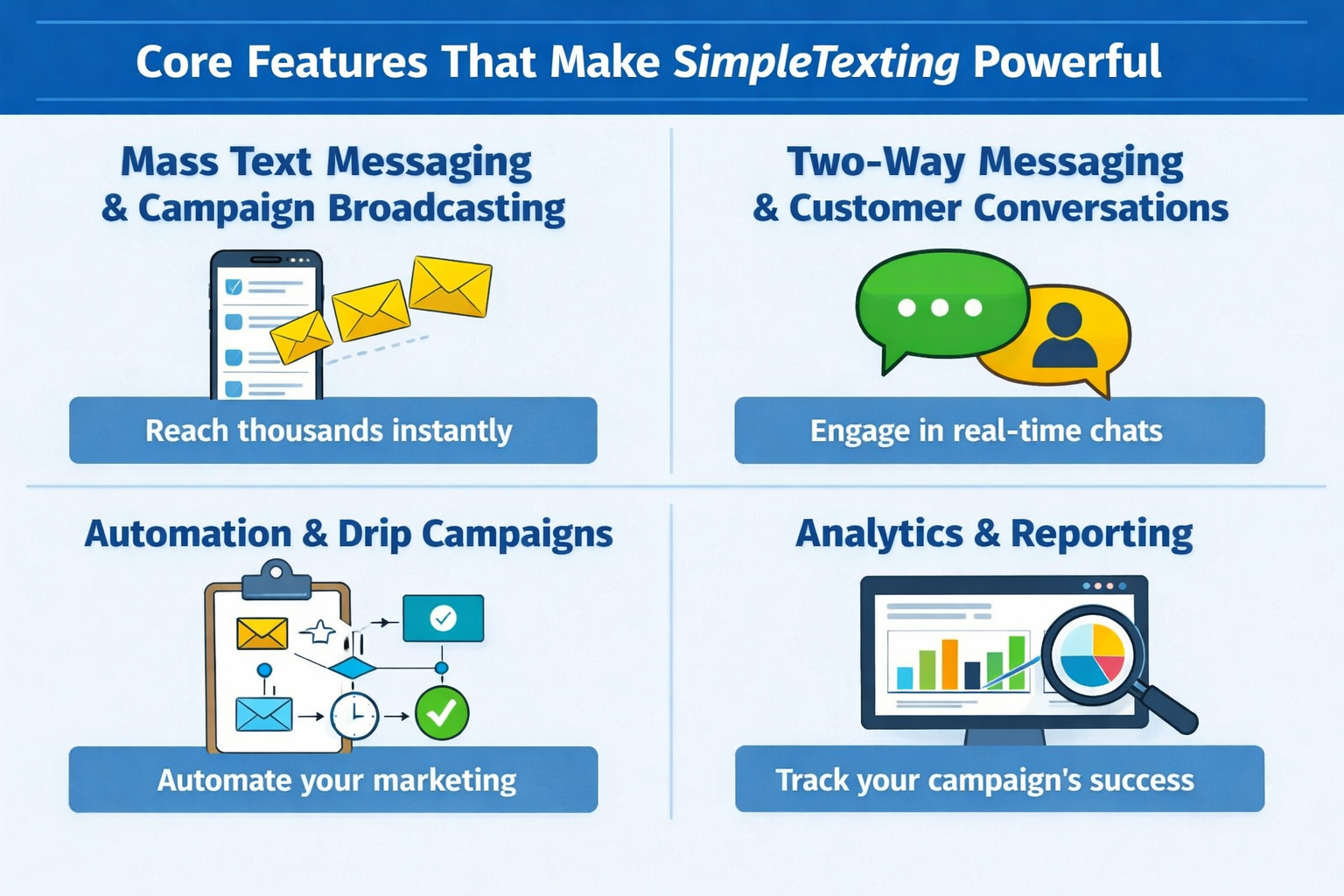
Core Features That Make SimpleTexting Powerful
Mass Text Messaging and Campaign Broadcasting
One of the most valuable features offered by SimpleTexting is mass text messaging, which allows businesses to send a single message to thousands of subscribers simultaneously. Imagine running a retail store and wanting to announce a weekend sale. Instead of relying on email newsletters that may sit unopened, you can send a quick SMS message that instantly reaches your entire audience.
Mass messaging is especially useful for time-sensitive promotions. Flash sales, event reminders, limited-time offers, and urgent updates are perfect examples of campaigns that benefit from SMS delivery. Because people typically read text messages almost immediately, businesses can generate quick responses and drive immediate action.
The platform also supports MMS messaging, which allows companies to include images, graphics, and other multimedia content in their messages. Visual elements can dramatically increase engagement by making promotions more attractive and informative.
Mass texting is not just about sending messages—it’s about sending the right message to the right audience. SimpleTexting allows businesses to segment their contact lists based on behavior, preferences, or demographics. This ensures that customers receive relevant messages rather than generic marketing blasts.
Two-Way Messaging and Customer Conversations
Traditional marketing often feels like a one-way broadcast. Businesses talk, and customers listen—or ignore the message altogether. SimpleTexting changes this dynamic by enabling two-way messaging, which turns SMS into a conversation rather than a monologue.
Two-way messaging allows customers to reply directly to text messages sent by a business. If a customer has a question about a promotion, they can simply respond to the text and receive assistance. This interactive experience builds trust and creates a sense of accessibility that many companies struggle to achieve through other channels.
Customer service teams benefit significantly from this functionality. Instead of managing endless phone calls or emails, support teams can respond to inquiries quickly through text conversations. Customers appreciate the convenience of texting, and businesses benefit from faster communication and reduced support workloads.
Two-way messaging also opens the door to customer feedback and engagement. Businesses can run polls, surveys, or quick questions through SMS to gather valuable insights. For example, a restaurant could ask customers to vote on new menu items, while a retail store could collect feedback about recent purchases.
This conversational approach strengthens customer relationships and makes communication feel authentic rather than transactional.
Automation and Drip Campaigns
Automation is another key feature that elevates SimpleTexting from a basic messaging tool to a full marketing platform. Businesses can create automated text campaigns, also known as drip campaigns, that send messages based on specific triggers or schedules.
For example, when a customer subscribes to a text messaging list, they might receive a welcome message followed by a sequence of promotional offers over the next few days. This automated journey helps nurture relationships without requiring manual effort from the marketing team.
Automation also works well for reminders and follow-ups. Appointment reminders, event confirmations, payment notifications, and delivery updates can all be automated. By reducing manual communication tasks, businesses free up time for more strategic work.
Consistency is another advantage of automation. Automated campaigns ensure that every customer receives the same high-quality communication experience. No leads are forgotten, and no opportunities are missed.
How SimpleTexting Helps Businesses Grow Faster
Lead Generation and Subscriber Growth
For many businesses, growth begins with building a strong customer list. SimpleTexting makes it easier to grow and manage SMS subscriber lists through features like text-to-join keywords and opt-in forms. Customers can subscribe simply by texting a keyword to a designated number.
This approach removes friction from the signup process. Instead of filling out lengthy forms, customers can join a business’s SMS list in seconds. Once subscribed, they become part of a highly engaged audience that can receive updates, offers, and announcements.
Businesses often promote these keywords through websites, social media pages, and in-store signage. For example, a retail store might encourage shoppers to text “SALE” to join the VIP discount list. This strategy helps businesses rapidly grow their audience while maintaining compliance with SMS marketing regulations.
The more subscribers a business has, the more opportunities it has to communicate directly with customers. Over time, this list becomes a valuable marketing asset that drives consistent traffic and sales.
Customer Engagement and Retention
Acquiring customers is important, but retaining them is even more valuable. Studies consistently show that repeat customers spend more and remain loyal to brands they trust. SimpleTexting helps businesses maintain strong relationships through ongoing communication.
Text messaging allows companies to stay top-of-mind without overwhelming customers. A short message about a new product launch, special discount, or upcoming event can remind customers why they chose a particular brand in the first place.
Engagement also improves when communication feels personal. Unlike social media posts that reach thousands of people simultaneously, SMS messages feel tailored to individual recipients. Even when sent to large audiences, text messages maintain a conversational tone that resonates with customers.
Businesses that regularly engage with customers through SMS often see improvements in customer lifetime value, brand loyalty, and overall satisfaction.
SimpleTexting Pricing and Plans Explained
Cost Structure and Credit System
SimpleTexting operates on a credit-based pricing model, where each text message sent consumes a credit from a monthly subscription plan. Entry-level plans start around $29 per month and include approximately 500 messaging credits, making the platform accessible even for small businesses.
As businesses grow, they can upgrade to higher-tier plans that provide larger credit allocations. Larger plans support tens of thousands of messages per month, making the platform scalable for enterprise operations.
Choosing the Right Plan for Your Business
The ideal plan depends on messaging volume and campaign frequency. Small businesses that send occasional promotions may only need basic plans, while large brands running daily campaigns require higher tiers.
One advantage of SimpleTexting’s pricing structure is that all plans include the same features—automation, analytics, integrations, and messaging tools. Businesses only pay more when they need to send more messages.
Best Industries That Benefit From SimpleTexting
Several industries have embraced SMS marketing due to its efficiency and immediacy:
- E-commerce and retail
- Medical services and healthcare
- Dining establishments and hospitality
- Events and education
- Financial services
These industries rely on timely communication, making SMS a natural fit for customer engagement and operational efficiency.
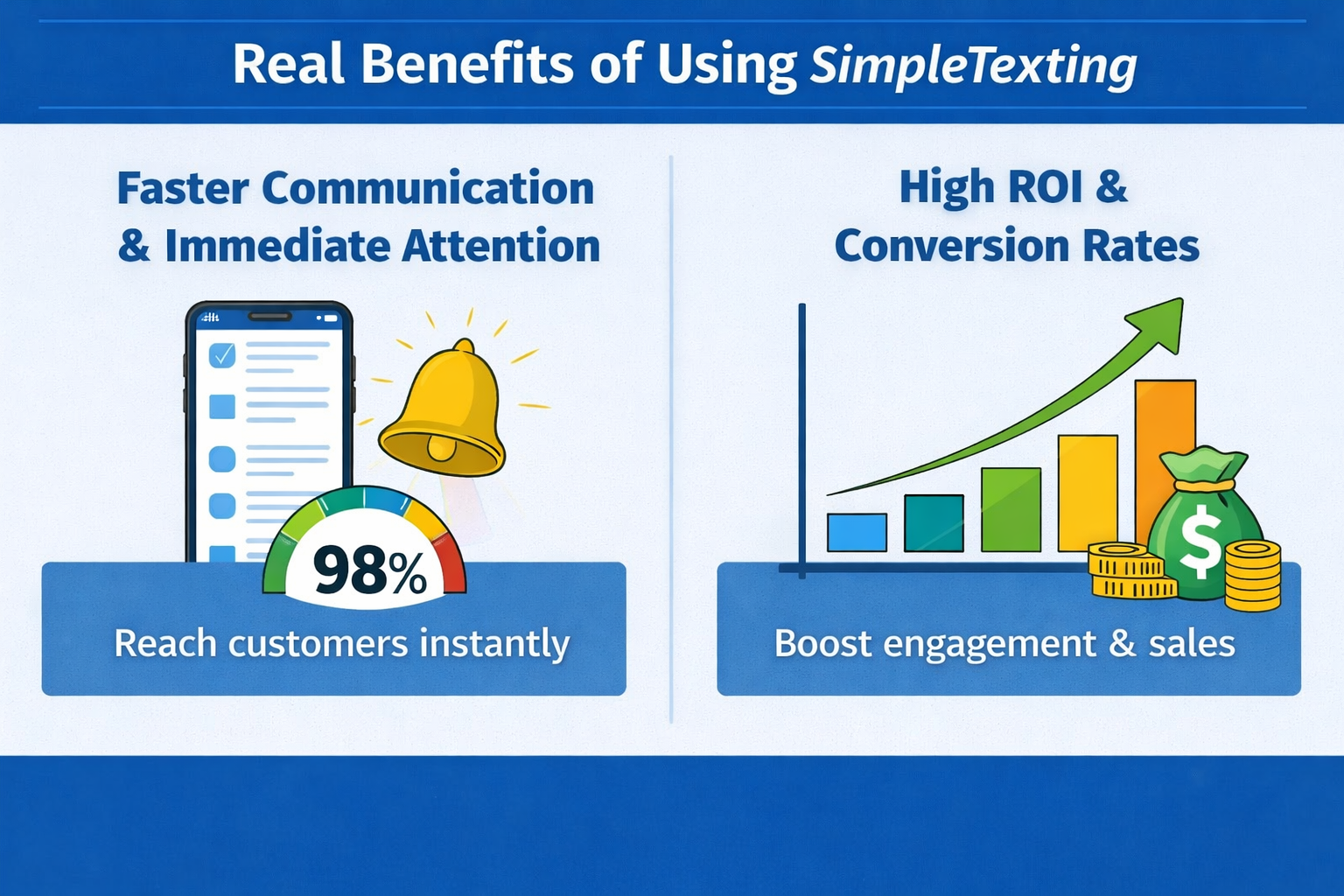
Real Benefits of Using SimpleTexting
Faster Communication and Immediate Attention
One of the main benefits of SMS communication is speed. When businesses send emails, they hope customers check their inbox soon. With text messaging, the response time is dramatically faster. Many people read texts within minutes of receiving them, making SMS ideal for urgent updates and promotions.
This immediacy becomes particularly valuable in industries where timing matters. Restaurants can send last-minute deals during slow hours, event organizers can remind attendees about upcoming activities, and service providers can notify clients about schedule changes.
Customers appreciate this speed as well. Instead of waiting hours for email responses, they can quickly communicate with businesses through text conversations.
High ROI and Conversion Rates
Marketing budgets are always under scrutiny. Businesses want to invest in channels that produce measurable results. SMS marketing consistently delivers strong financial returns because of its high engagement rates.
Some reports indicate that SMS campaigns can generate conversion rates around 8% and ROI ratios exceeding 40:1, depending on the campaign type. These numbers demonstrate why many companies prioritize SMS as part of their digital marketing strategies.
The combination of low cost and high engagement makes SMS one of the most efficient marketing channels available today.
Best Practices for Successful SMS Marketing Campaigns
Successful SMS campaigns require thoughtful strategy. Businesses should focus on delivering value rather than sending constant promotional messages. Customers are more likely to stay subscribed when they receive useful information or exclusive offers.
Messages should also be short and clear. Text messaging works best when communication is concise and easy to understand. Adding clear calls to action—such as links, discount codes, or appointment confirmations—helps guide customers toward the desired response.
Challenges and Compliance in SMS Marketing
Despite its benefits, SMS marketing requires careful compliance with regulations. Businesses must obtain explicit consent before sending marketing messages and provide easy opt-out options for subscribers.
Failure to follow these rules can result in significant penalties. Some regulations allow fines of $500 to $1,500 per unauthorized message, emphasizing the importance of proper compliance procedures.
Responsible messaging practices not only avoid legal risks but also build trust with customers.
The Future of SMS Marketing and Business Messaging
The future of business communication is becoming increasingly conversational. As artificial intelligence, automation, and mobile technology evolve, SMS marketing platforms will continue to expand their capabilities.
Businesses are already experimenting with AI-powered messaging assistants, personalized campaigns, and integrated omnichannel marketing strategies. SMS will likely remain a central component of these systems because of its reliability and simplicity.
Platforms like SimpleTexting are positioning themselves at the intersection of technology and human communication—combining automation with personal interaction.
Conclusion
Effective communication is essential for business expansion. Companies that connect with customers quickly, personally, and consistently have a significant advantage in competitive markets. SMS marketing provides exactly that opportunity, delivering messages directly to customers’ mobile devices with unmatched visibility and engagement.
SimpleTexting simplifies this process by offering powerful messaging tools, automation capabilities, and scalable pricing plans. From small businesses sending occasional promotions to enterprises managing large-scale campaigns, the platform provides everything needed to leverage the power of text messaging.
As digital marketing continues to evolve, one thing remains clear: direct communication builds stronger relationships. Businesses that embrace SMS platforms like SimpleTexting can unlock new opportunities for engagement, loyalty, and revenue growth.
Frequently Asked Questions